Interiors
Over the period 2011-2014 the palace interiors witnessed restoration works. Results of mortar analysis and new iconographic sources allowed to create new look of the interiors.
The rooms in the palace have been restored in the style closer to the original of the days when the Herbsts actually lived here. Discovered photographs made it possible to reconstruct many details and elements, which gave individual character to the rooms. Interiors have been furnished with furniture, paintings, and masterpieces of decorative art of the 19th and the early 20th centuries.
HERBST PALACE – GROUND FLOOR
1. Vestibule
Vestibule is a glamorous lobby hosting the main staircase. Original decorations in this part have been restored. We can find here bronze sculptures of knights holding spears crowned with lamps.
2. Studio
In the studio there is 19th century furniture: neo - Baroque bookshelves, a leather coach and neo-Renaissance desk and an armchair. Under the window on a column we can see a marble bust of Karol Wilhelm Scheibler – Matylda’s father – by Albert Rachner (1846 – 1900) dated ca. 1881. On the walls, inter alia, family photos and lithographs of Petersburg from the collection of one of the Łódź industrial tycoons, by Alexander Orłowski (1977-1832) (?). The floor is covered with Oriental rug (early 20th century).
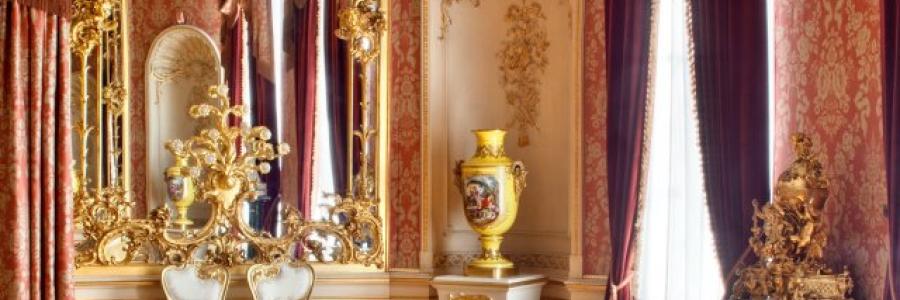
3. Mirror room
The room distinguishes itself with rich decorations in neo-Rococo style. Elements, which have been preserved from the original decor include, inter alia, wood panels, generously sculpted, and gold-plated mirror frames, door toppers with allegory representations of the seasons of the year: spring, summer and autumn. The ceiling is ornamented with plaster decorative coatings and canvas plafond paintings. Original accessories are also reminded by ceramic stoves (4th quarter of the 19th century) and a bronze chandelier (France, 19th century). The room is furnished with the 19th-century furniture. A small table with porcelain miniatures attributed to a Vienna manufacturer (ca. 19th century) will surely attract our special attention. Between the windows, on a console table, we can see a clock in gold-plated bronze - France, 2nd half of the 19th century. On the walls paintings depicting mythology scenes by Andrea Locatelli (1693-1741).
4. Oriental-style room
Because of the colour of its walls, in the interwar period the room was called „yellow”. Nowadays, it hosts an Oriental-style room, a place where the host or the hostess could exhibit their collection of works and products originating from Asia (whose culture got a lot of attention in the 2nd half of the 19th century). There is a collection of the 19th century furniture originating from China and imitations of oriental products from Europe. Left to the entrance, on the wall a painting by Camille Rogier (1810?–1896) entitled Oriental Market. On the right, a sculpture of Guardian made of patinated bronze (Japan, 3rd quarter of the 19th century). Under the window, a faience figure of Kannon – the goddess of mercy (Japan, ca. 19th century)
5. Dining room
Walls of the dining room are covered with oak wood panelling. In line with the room´s function, the main and the most important piece of furniture here is a table (2nd half of the 19th century) set for dinner. Besides, there are: a cupboard on the right and a display cabinet (early 19th century) on the left, both used to store the tableware. At the door there is a side table used to put spices or serving dishes brought from the kitchen. A porcelain dinner-set on the table is Flora Danica (Denmark, 1st half of the 20th century) decorated with plant motifs from a herbarium. On the fireplace we can find a Secessionist-style jardinière from Warsaw metal workshop of Roman Plewkiewicz. On the walls we can admire still life paintings with the artwork of Johan Georg de Hamilton (1672–1737) entitled Pheasants (right from the entrance).
6. Middle room
Another reception, room decorated in neo-Rococo style.
Elements remaining from original decorations include: moulded decoration of the ceiling, wood panelling and the housing of an arcade with mirrors built in its doors. The room is decorated with 19-century accessories. Pleyel made piano is worth paying attention. Right from the entrance a glass cabinet – a piece of furniture used to display, e.g., porcelain pieces (porcelain and faience figures from European manufacturers from the late 19th and early 20th centuries). Above the piano a Portrait of a Young Woman by Leon Wyczółkowski (1852–1936), on the side of the fireplace, a work by Alexander Gierymski (1850-1901) Study I for Painting „Arbor”.
7. Hunter’s room
Room for men also used as a smoking room. Oak wood panelling and coffered ceiling were made in 1881 on Edward Herbst’s order. Wardrobes hidden in wood panels were used for storing fire guns and billiard clubs. Central space in the room is occupied by a billiard table used to play carambole. At a side, a folding card table. The final touch comes from watercolours by Juliusz (1824 – 1869) and Jerzy (1886 – 1955) Kossak and Artur Grottger (1837 – 1867).
8. Big Hall
Usually, big hall was used as a big reception hall rather than a ballroom. In its eastern part divided into two storeys, there is a balcony for musicians. The room is furnished mostly with 20th-century furniture (early). In the corner of the hall there is a 19th-century quarter clock. Our attention will be attracted also by a sculpture Young Columbus made in Florence by Antonio Garella (1862–1919). Paintings on the wall are: Giovanni Battista Ruoppolo (1629-1693) Autumn Harvest Allegory, and J. B. Belin (1653-1715) Flowers.