

History
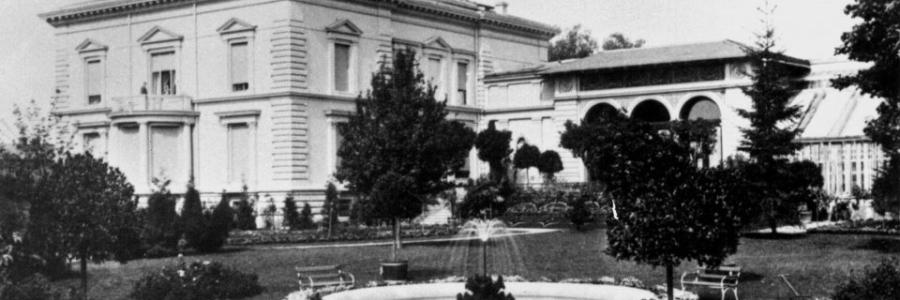
The area directly neighbouring the Jasień River turned into the site where a powerful textile company of the Scheibler family developed. It exerted fundamental impact upon the development of textile industry in Łódź.
Karol Wilhelm Scheibler (1820–1881) was a Belgian citizen who arrived in Łódź in the mid-19th century. In 1869 he became the owner of a state-of-the-art, integrated enterprise. In 1870 he purchased water and industrial grounds of Księży Młyn and Wójtowski Młyn (Mayor’s Mill) bordering the Wodny Rynek (Water Market). Soon he initiated the construction of a four-storey brick building of a spinning mill followed by a weaving mill in Księży Młyn. Most probably, it was at the same time when the construction of a housing district for workers started. Together with tenant houses, Księży Młyn housed all the necessary social services: a store, elementary school, hospital, and a pharmacy. Księży Młyn was an independent, self-sufficient organism, capable of meeting all the needs of its residents. „Some people had spent their entire lives here and had never been to Łódź” –former residents of Księży Młyn recall.
Herbst residence makes an integral part of the industrial and residential area. The villa is situated in the garden, in the vicinity of industrial facilities but the residential area clearly distinguishes itself from the neighbouring buildings and forms a characteristic enclave. The construction of the villa started the most likely around 1875 in connection with Matylda Scheibler’s marriage to Edward Herbst, for whom the villa was intended. Iconographic materials of the 1880s depict the entire complex of buildings. The house of Matylda and Edward Herbst was designed as a one-storey neo-Renaissance villa. In its immediate proximity there is a building housing the so called big hall, joined to the orangery with a glass-covered passage. Next to the villa we can find a storeyed annexe building. Its ground floor was occupied by a kitchen and a pantry. The other wing housed garages. Storeys were used mostly for rooms occupied by the housekeeper and the maids.
Another outbuilding designed by Adolf Seligson (1867–1919) was erected in red brick and decorated with an ornament made of plaster. The building housed a carriage house and stables while in its tower there were rooms for servants.
The residence remained in the hands of the Herbst family until 1942. Two generations of the family lived there: first Matylda and Edward and then their son Leon with his wife Alexandra. After Leon’s death (1942) Alexandra left Łódź.
In the years following World War II the palace was nationalised. It took on various functions, e.g., that of a training centre for social welfare workers, a daily treatment centre for mentally ill, it hosted Volunteer Reserve Militia (Polish abbr. ORMO) and even a disabled cooperative. Subsequent improper uses of the building led it to the state of dereliction.
When in 1976 the residence was taken over by the Muzeum Sztuki, all the buildings required structural works.